Every SIA licence holder in the security industry has the same qualification. Standing out takes more than just being licensed.
There are over 430,000 active SIA licence holders in the UK. Every one of them passed a course to earn their badge. But here’s what nobody talks about enough: passing a course and staying competent are not the same thing.
Your SIA licence lasts three years. Your skills don’t.
Whether your SIA training was a six-day door supervisor course, a four-day security guard programme, or a three-day CCTV qualification, it packed a lot into a short period.
But you’re not performing CPR every shift. You’re not restraining aggressive individuals every weekend. You’re not managing evacuations on demand. Yet when those situations arrive, you need to respond in seconds. No warm-up. No rehearsal.
That’s the problem the GuardPass Skills Passport was built to solve. And if you’re serious about your security career, this is how you stay sharp, stay current, and stand out.
What Is the Skills Passport?
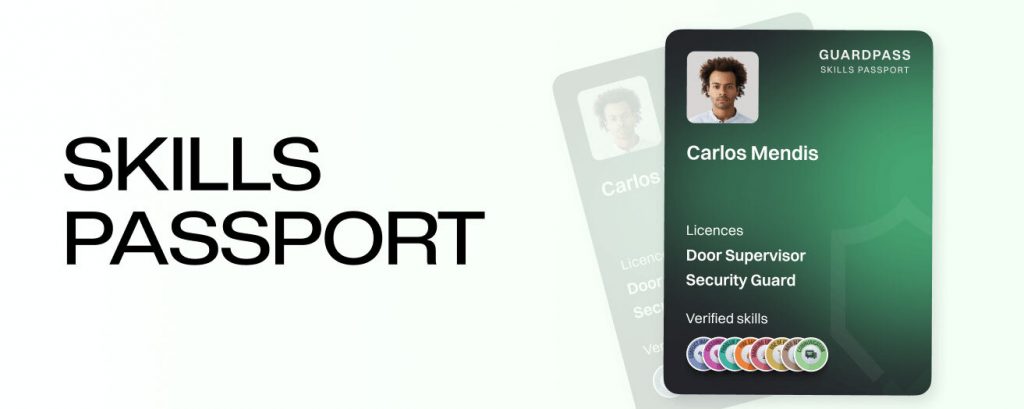
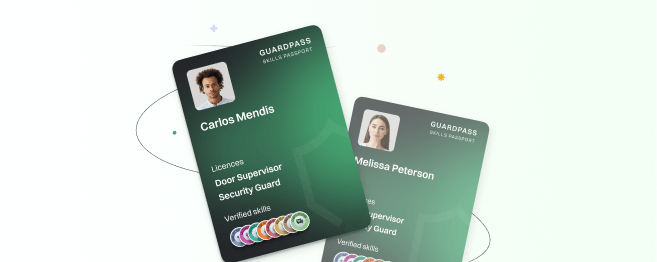
We’ve rebuilt the profile experience inside the GuardPass app. Your skills, licences, and work history now live in one place: your Skills Passport.
It’s everything employers care about, in one view. No digging. No duplication.
Here’s what it includes:
- Your SIA licence details: Displayed prominently on your passport, and now available to add directly to Apple Wallet or Google Wallet, so it’s always on your phone.
- 100+ skill badges: Earned by completing flashcards and quizzes across a wide range of security-specific topics. Each badge represents demonstrated knowledge in a specific area: conflict de-escalation, emergency response, counter terrorism awareness, search procedures, physical intervention, and more.
- A living record that updates as you do: This isn’t a static profile. As you earn badges, refresh your skills, and level up, your passport grows with you. It becomes proof of ongoing competence, not just a qualification you got years ago.
But here’s the part that makes it different from every other badge or certificate system: your badges expire.
Just like real skills fade over time, your badges don’t last forever. You have to refresh them. Complete quizzes, work through flashcards, and keep coming back. That’s how you keep them active on your passport.
Let a badge lapse, and it drops off.
If a badge expires, employers can’t see it. Only active badges show on your passport.
Why Your Skills Fade Faster Than You Think
Badge expiry isn’t a gimmick. It’s built on well-established cognitive science.
In 1885, German psychologist Hermann Ebbinghaus conducted pioneering research into how memory deteriorates over time. His findings, known as the Forgetting Curve, were replicated and confirmed in a 2015 peer-reviewed study by Murre and Dros.
The research consistently shows the same pattern: without reinforcement, most people retain under 15% of what they originally learned after just 60 days.
That means if your last training was months ago, the vast majority of what you were taught has already faded. Not because you weren’t paying attention. Because that’s how memory works.
Individual results vary depending on the material and the learner, but the trajectory is consistent across studies: without deliberate practice, knowledge disappears faster than most people expect.
This applies to everyone, in every field. But in security, where the ability to respond correctly under pressure can mean the difference between a managed situation and a dangerous one, the stakes are higher.
Your SIA course covered critical competencies. Conflict management, physical intervention, emergency first aid, counter terrorism awareness. But if you haven’t revisited any of that material in months, how much do you actually retain?
The SIA has acknowledged this through its push for refresher training requirements. The industry is shifting towards continuous professional development. Officers who are already maintaining their skills aren’t just keeping up. They’re ahead.
The Skills Passport mirrors this reality. Badges expire because skills fade. And the way to fight it is the same way pilots, paramedics, and surgeons do it: regular, spaced practice.
What This Means for Frontline Security
Security is a frontline profession. The people doing this work are responsible for public safety, conflict resolution, emergency response, and the protection of people, property, and businesses. Every single day.
The skills behind that work are not optional. They are critical. And they fade without regular practice.
When skills fade, and nobody notices, incidents get handled badly. Response times slow down. Situations escalate when they didn’t need to. The consequences are real, and they affect real people.
Right now, the industry has no standardised way to verify whether an officer’s skills are still current after they’ve been licensed. An SIA licence confirms that someone passed a course. It doesn’t confirm they still remember what they learned.
That’s a gap that affects everyone. The officers on the ground, the employers hiring them, and the public relying on them.
The Skills Passport is built to close that gap. It gives officers a practical way to keep their skills fresh through regular flashcards and quizzes. And it gives them visible proof that they’re doing it.
The SIA is already moving towards a model where continuous professional development plays a bigger role in licensing. Employers are increasingly looking beyond the badge to see what their officers are doing to stay current. The direction is clear.
A licence proves you passed a course. A Skills Passport full of active badges proves you take your profession seriously. That matters when you’re applying for a better role, when your employer is deciding who to put forward for a contract, or when a client asks what their security team does to maintain standards.
What Skills Can You Practise?
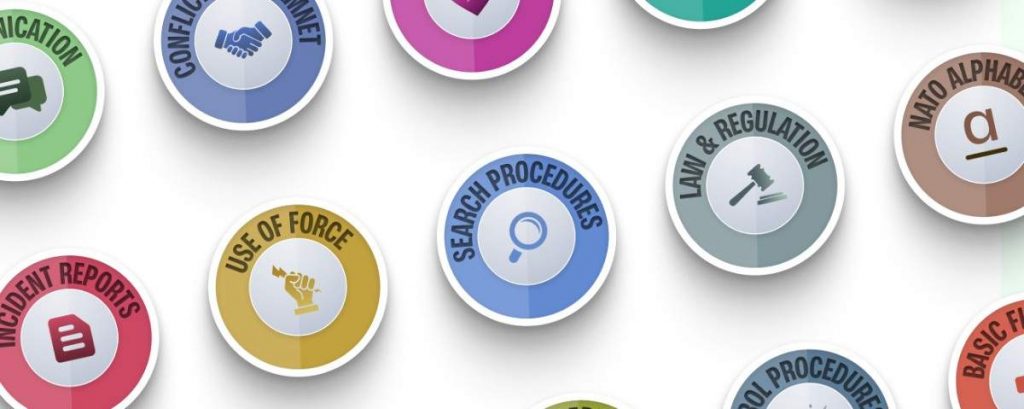
Over 100 skill badges span the core competencies of front-line security work, and the library keeps growing. Here are some examples of what’s available:
- Conflict Management and De-escalation: The most used skill in security and the one that fades fastest. Verbal techniques, managing aggression, and knowing when to disengage.
- Physical Intervention: Holds, escorts, restraints, and the legal framework around reasonable force.
- Emergency Response and First Aid: CPR, defibrillator use, treating bleeds, managing shock.
- Counter Terrorism Awareness: ACT awareness, hostile reconnaissance, suspicious packages, evacuation protocols.
- Communication and Customer Service: Professional interaction, handling complaints, managing vulnerable people.
Other categories include access control, CCTV and surveillance, fire safety, report writing, and site awareness, with more being added regularly.
Whatever your role, whether that’s door supervisor, security guard, CCTV operator, or event security officer, there are badges directly relevant to what you do every day.
How It Works: Flashcards, Quizzes, and Levelling Up
The same body of research that identified the Forgetting Curve also identified the fix: spaced repetition. Revisiting learned material at timed intervals strengthens retention. Each review extends how long you remember it.
This is used across medicine, aviation, and military training, and now it’s built into the Skills Passport.
Here’s how it works in practice:
- Flashcards reinforce core knowledge in short, focused bursts. Work through them on a break, before a shift, or on your commute. They target specific competencies and keep the fundamentals fresh.
- Quizzes go beyond recall. These are scenario-based questions that test your ability to apply knowledge. The kind of decision-making you need when something actually happens on-site.
- Badge expiry keeps you honest. Because badges decay over time, you’re naturally prompted to revisit skills before they lapse. It creates a rhythm of ongoing practice without requiring you to book another course or take a day off work.
From Basic to Expert: How Progression Works
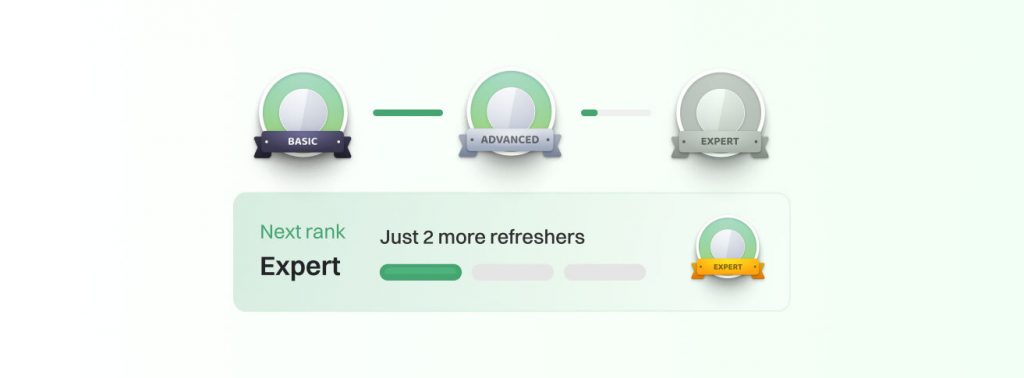
Every skill badge has three levels: Basic, Advanced, and Expert. You don’t unlock higher levels by taking harder quizzes. You earn them by consistently maintaining the skill over time.
Basic is earned when you pass the first quiz for a skill. This confirms you know the fundamentals.
Advanced is earned after you complete two refreshers for that skill. Each refresher becomes available after a set period, so you have to come back and prove you still know the material. This is where spaced repetition does the work.
Expert is earned after three more refreshers beyond Advanced. By this point, you’ve revisited the same skill multiple times over weeks and months. That level of consistency signals genuine, sustained competence.
Your passport tells the full story. Someone with Basic badges across many categories shows broad awareness. Someone with Expert badges in conflict management and emergency response shows they’ve put in the work to maintain specialist depth over time.
Someone who has built both? That’s a well-rounded, highly competent security professional, and the passport proves it.
This isn’t about collecting badges for the sake of it. It’s about building real capability, proving it to yourself, and having something concrete to show for it.
Stay Consistent with Streaks
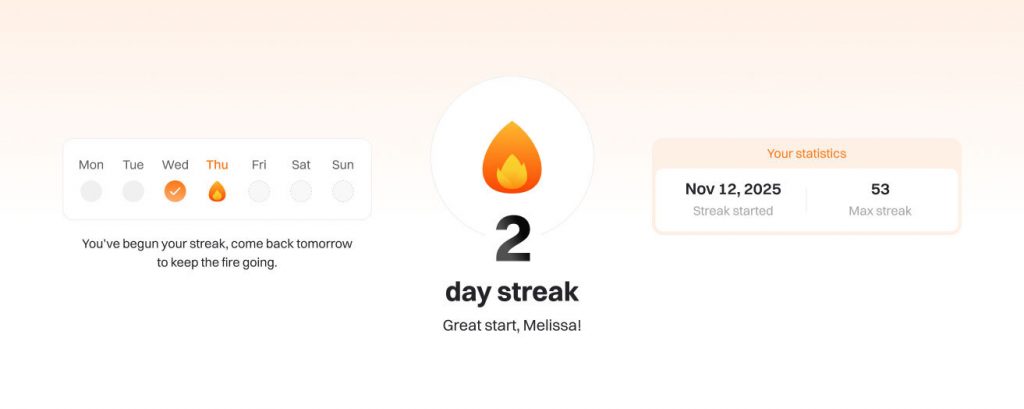
Building your skills works best when it becomes a habit, not a one-off. That’s why the Skills Passport includes streaks.
Complete a quiz or daily challenge each day to keep your streak going. It takes a few minutes. Short enough to fit into a break or a commute. The streak tracks your consistency and helps you build the kind of regular practice that spaced repetition relies on.
Miss a day and your streak resets, but you can always start again. The point isn’t perfection. It’s making skill maintenance a routine, not something you remember to do once a month.
How to Get Started
Here’s how to set it up. It takes minutes and costs nothing.
- Download the GuardPass App
Free on the App Store or Google Play. If you’ve already got it, make sure you’re on the latest version. - Set Up Your Skills Passport
Add your details and SIA licence information. Already have an account? Your existing badges have carried over. They’re in your new passport, ready to refresh and level up. - Add Your SIA Licence to Your Wallet
Straight into Apple Wallet or Google Wallet. Digital, always with you, always accessible. - Start Earning Badges
Browse skill categories. Complete flashcards and quizzes. Start with whatever’s most relevant to your current role. - Keep Them Active
Badges expire. Come back regularly, refresh your knowledge, and progress from Basic to Advanced to Expert. A few minutes a week keeps your passport (and your competence) alive.
Don’t try to do it all in one sitting. The whole point is little and often. That’s what the science says works, and that’s exactly how the passport is designed.
Security professionals across the UK use GuardPass daily. The Skills Passport is now live for all of them.
Stay job-ready long after training ends. Stand out to employers with proof that your skills are current.
Download the GuardPass app and start building your Skills Passport today.