
Winning a new security contract is the part everyone celebrates. Whether it’s a retender you’ve taken from another provider, a private client adding sites, or a call-off from a public-sector framework, the client expects SIA-licensed, properly screened officers on site from the first shift.
The weeks between award and go-live, the mobilisation window, are where new contracts are won or quietly lost. Too few officers, a vetting backlog or an expired licence on day one can damage a client relationship before it has properly started.
It’s a challenge more mid-sized contractors are facing. Manchester-based Universal Support Services Group, for example, recently secured places on CCS and ESPO security frameworks, which open the door to public-sector call-offs covering static guarding, mobile patrols, keyholding and alarm response. Every one of those wins comes with a mobilisation to deliver.
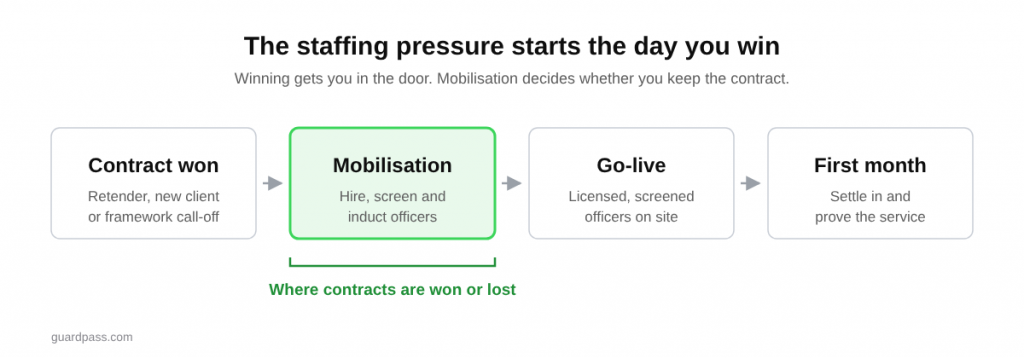
“Winning the contract gets you in the door. Mobilisation decides whether you keep it.”
Security Contract Mobilisation in Five Steps
These five steps take you from award letter to a fully staffed first shift. Each one removes a reason your go-live date could slip.
1. Work Out How Many Security Officers the Contract Needs
Start with the specification, not your gut feel. Every post has hours, a licence requirement and a pattern of cover, and those three things set your hiring number. For each post, record:
- Hours of cover per week (a 24/7 static post is 168 hours)
- The SIA licence type required: Security Guarding, Door Supervision, CCTV (Public Space Surveillance) or Close Protection
- Any extra requirements, such as keyholding, first aid or a site-specific induction
- Whether the post is static, mobile or response
Then convert hours into people. Under the Working Time Regulations, officers work an average of 48 hours a week unless they have opted out. Statutory holiday is 5.6 weeks a year, roughly 11% of working time, so relief has to be built in from day one. Here’s how that works for a single 24/7 post:
| Calculation | Figure |
|---|---|
| Weekly hours for one 24/7 post | 168 |
| ÷ Average hours per officer | 48 |
| = Core officers, with no relief | 3.5 |
| + Relief at 15.8% (holiday plus 5% absence) | 0.55 |
| = Officers needed, rounded up | 5 |
The 5% absence allowance is an example. Use your own sickness and training data.
Running a contract with several posts or sites? Our free Contract Mobilisation Workforce Planner includes a headcount worksheet and the common shift patterns to work it out post by post.
2. Check Who Transfers Under TUPE When You Take Over a Contract
Most guarding contracts change hands at retender, so many mobilisations start with a team that already exists. A change of contractor is a service provision change, and TUPE usually applies where there is an organised group of employees working on that contract. Acas guidance is clear that everyone assigned to that work transfers automatically, and the new employer cannot pick and choose.
Your external hiring number may be smaller than the headcount suggests, but you inherit people you have not recruited, screened or managed. Before go-live, ask the outgoing contractor for the employee liability information and check each transferring officer’s SIA licence type and expiry, right to work documentation, screening records and contracted hours. Treat any gaps as hiring needs, and take employment law advice on the transfer itself.
3. Recruit SIA-Licensed Officers, Not Just Applicants
Once you know the gap, speed comes from where you look. A general job board brings volume, but many applicants may not hold the right licence, or any licence at all. Every one of them costs you screening time you do not have.
Recruiting from a pool of SIA-licensed security professionals removes that first filter. Whatever the source, check every licence against the SIA’s public register before you make an offer and confirm the licence type matches the post. Fake and borrowed licences are a real risk, and a rushed mobilisation is exactly when they slip through.
4. Plan Your BS7858 Vetting Timeline Backwards From Go-Live
Screening is where most mobilisations stall. BS7858 requires a minimum five-year screening period, and a candidate with gaps, self-employment or slow referees can take far longer than a straightforward case. So work backwards: fix the date every officer must be screened and inducted, subtract your realistic screening time plus a buffer, and you have the latest date any new hire can start screening.
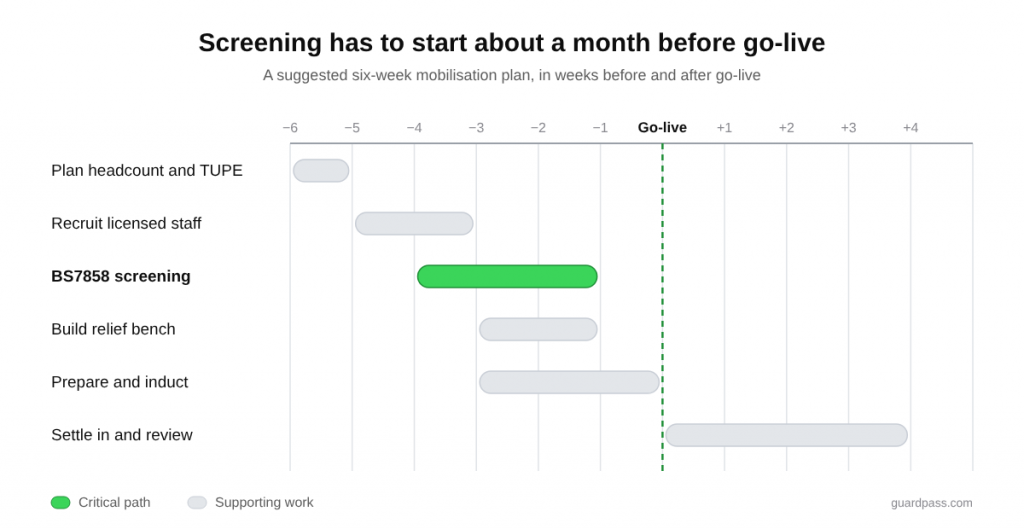
Start screening as soon as a candidate accepts, not once the whole team is hired, and run checks in parallel rather than one after another. BS7858 does allow provisional employment in defined circumstances, but it depends on preliminary checks, a documented risk assessment and completing full screening within the timescales the standard sets. Check your client’s contract terms too.
5. Build a Relief Bench Before You Need It
The first month of a new contract is when sickness, no-shows and early leavers hurt most. A small bench of screened, licensed and site-inducted relief officers is the safety net, and it lets you say yes when the client adds posts or asks for temporary emergency cover. For more on this, see how to build a flexible guard pool without sacrificing standards.
Where the Risk Concentrates
The second dataset breaks the 22,526 right-to-work revocations down by the licence holder’s nationality, across 110 separate categories (a small number of which are administrative labels such as ‘Other’, ‘None’ and ‘Not Known’, rather than nationalities). Five nationalities account for the large majority:
Common Security Contract Mobilisation Mistakes
- No relief built in. The rota works on paper and breaks the first time someone books a holiday.
- Screening started too late. Vetting the whole team in one batch creates a bottleneck right before go-live.
- Licence expiry ignored. An officer whose licence lapses mid-contract is a compliance gap waiting to happen.
- TUPE assumptions. Assuming the transferring team is fully licensed and screened without checking.
- Records not audit-ready. Clients, especially in the public sector, may ask for evidence of licensing and screening at short notice.
Frequently Asked Questions
How many security officers do you need for a 24/7 site?
At 48 hours per officer, one 24/7 post needs 3.5 officers for core cover. Once you add relief for holiday, sickness and training, most contractors need four to five officers per 24/7 post.
Does TUPE apply when you take over a security contract?
Often, yes. A change of contractor is a service provision change, and TUPE usually applies where an organised group of employees works on the contract. Take employment law advice for your specific situation.
Can security officers start work before BS7858 screening is complete?
BS7858 allows provisional employment in defined circumstances, subject to preliminary checks, a documented risk assessment and completing full screening within set timescales. Check your client’s contract terms too.
Conclusion
Winning the contract gets you in the door. Plan the headcount early, check every licence and every TUPE record, start screening the moment someone accepts, and have relief ready before you need it.
GuardHire puts your vacancies in front of SIA-licensed security professionals, and GuardCheck runs BS7858:2019 screening with checks carried out in parallel, so a new contract doesn’t stall on vetting admin.
Planning your next go-live? Download the free Contract Mobilisation Workforce Planner for the headcount worksheet, timeline and day-one checklists.
Book a free demo to see how GuardPass can help you mobilise your next contract