
On 19 August 2026, the Security Industry Authority (SIA) published five years of licence revocation data in response to a Freedom of Information request (FOI reference 0621). The release covers every SIA licence revocation recorded between 1 January 2022 and 2 August 2026, broken down by reason, alongside a second dataset showing right-to-work revocations by nationality.
Most security employers plan their vetting around the risks that make headlines: violence, weapons, dishonesty. The SIA’s own numbers say that’s not where the licensed workforce is actually being lost.

The Compliance Blind Spot the Data Exposes
Of the 24,969 SIA licences revoked between January 2022 and 2 August 2026, 22,526 (90.2%) were pulled for one reason: the licence holder no longer had the right to work in the UK.
Violent or abusive behaviour, sexual behaviour, drug use or supply, dishonesty and fraud, offensive weapons, criminal damage, abuse or neglect of children, and driving offences: these are the categories most operators actually build their vetting programmes around, and together they account for 2,006 cases. That’s just over 8% of everything the SIA has revoked in almost five years.
| Revocation reason | Total (Jan 2022–Aug 2026) | Share of total |
| No right to work | 22,526 | 90.2% |
| Violent/abusive behaviour | 1,065 | 4.3% |
| Other (predominantly right-to-work related) | 640 | 2.6% |
| Sexual behaviour | 265 | 1.1% |
| Drug use/supply | 231 | 0.9% |
| Dishonesty (theft & fraud)/proceeds of crime | 162 | 0.6% |
| Offensive weapons/firearms | 129 | 0.5% |
| Criminal damage | 80 | 0.3% |
| Abuse or neglect of children | 58 | 0.2% |
| Private Security Industry Act offences | 41 | 0.2% |
| Driving offences | 16 | <0.1% |
| Operation Siren/espionage & terrorism (combined) | <20 | <0.1% |
Source: SIA licence revocation data, January 2022–2 August 2026.
“9 in 10 SIA licence revocations in the past five years had nothing to do with violence, weapons or dishonesty. They came down to one thing: the licence holder’s right to work had lapsed.”
The SIA also notes that the “Other” category (640 revocations) is largely linked to right-to-work issues. When these cases are included, right-to-work problems could account for more than 92% of all licence revocations in the dataset.
Why This Should Change How You Think About Risk
Here’s the strategic problem. A vetting programme built to catch the 8% (the officer who hides a conviction, the candidate with an undisclosed weapons charge, the applicant who fails a drugs screen) is necessary work, and it should stay part of any serious screening process. But it isn’t what’s actually thinning out licensed workforces at scale.
The thing quietly costing operators their headcount is administrative: a Biometric Residence Permit that expired without anyone noticing, a pre-settled status condition that changed, a visa route that ran out mid-contract.
A right-to-work check at the point of hire only proves one thing: that someone was eligible to work on the day the check was done. It says nothing about whether they’re still eligible six months later, or eighteen. Visas expire on fixed dates. Pre-settled status has to convert to settled status by a deadline. None of that resurfaces unless someone goes looking for it, and for most security employers checking manually or only at onboarding, nobody is.
The Trend is Accelerating, Not Stabilising
The SIA only began systematically recording revocation reasons in December 2021, which makes 2022 the first full year of comparable data. Right-to-work revocations since then:
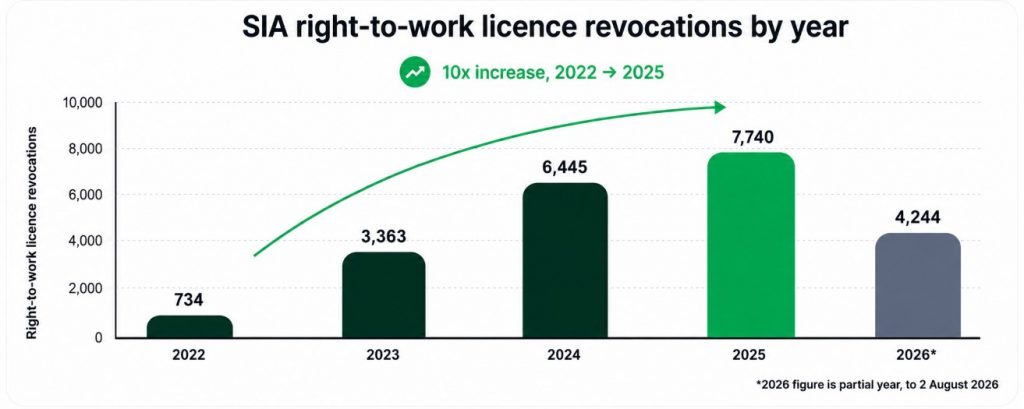
Right-to-work licence revocations by year: 2022 – 734 · 2023 – 3,363 · 2024 – 6,445 · 2025 – 7,740 · 2026 (to 2 August, partial year) – 4,244.
That’s more than a tenfold increase from 2022 to 2025. With exactly five months of 2026 still to run at the time of this release, the year is already tracking toward a similar range to 2025, not a decline. Whatever combination of tighter Home Office enforcement, sharper SIA checks and workforce composition shift is driving this, the direction has held for four years running. Plan your compliance calendar around a curve that’s still rising, not one you’re hoping will flatten.
Where the Risk Concentrates
The second dataset breaks the 22,526 right-to-work revocations down by the licence holder’s nationality, across 110 separate categories (a small number of which are administrative labels such as ‘Other’, ‘None’ and ‘Not Known’, rather than nationalities). Five nationalities account for the large majority:
| Nationality | Revocations (Jan 2022–Aug 2026) | Share of RTW total |
| Pakistani | 9,625 | 42.7% |
| Indian | 7,861 | 34.9% |
| Nigerian | 2,898 | 12.9% |
| Bangladeshi | 707 | 3.1% |
| Ghanaian | 429 | 1.9% |
These five nationalities alone account for roughly 95% of all right-to-work revocations in the dataset.
It’s important to be clear about what this data shows. A ‘no right to work’ revocation usually reflects a change in immigration status, such as an expired visa or change in settled status. It does not mean the licence holder has acted dishonestly or done anything wrong. For employers with large numbers of workers from these communities, the message is simple: right-to-work checks should be monitored regularly, not just once a year.
The Legal Exposure You’re Already Carrying
The risk goes beyond losing a member of staff. Under the Immigration, Asylum and Nationality Act 2006, employers who complete the correct right-to-work check when hiring are protected from a civil penalty if that person later loses their right to work. However, for workers with time-limited permission, this protection only lasts until that permission expires.
The Home Office’s own guidance is explicit: employers have to carry out a follow-up check on or before the date that permission expires to keep the excuse and keep employing that person lawfully.
Miss that check, and the risk goes beyond having a licensed officer missing from the rota. Since February 2024, employers can face civil penalties of up to £45,000 per illegal worker for a first breach and £60,000 for a repeat breach. When you look at the SIA’s figures, this isn’t just a potential risk. It’s an issue already affecting the security industry at scale.
Build This Into Your Compliance Strategy, Not Your Onboarding Checklist
A right-to-work check at onboarding confirms someone’s status at that point in time. It does not tell you what happens when their permission changes months or years later. That’s the gap this data exposes.
The answer is to make right-to-work part of your ongoing compliance process, with clear expiry dates, follow-up checks and a reliable record of what was checked and when.
GuardCheck consolidates the right-to-work, identity, DBS, employment history and SIA licence checks you’d otherwise run separately, and is independently certified to BS 7858:2019 and NSI NCP 111. For licence validity day to day, Licence Hub checks your register against the official SIA database daily and flags issues by email.
What This Means For Your Compliance Strategy
The data points to a simple shift in priorities. Right-to-work should be an ongoing workforce responsibility, not something that ends when an employee passes their initial checks.
- Track time-limited permission: Record when each employee needs a follow-up check and act before the deadline.
- Keep clear records: Maintain evidence of checks, documents and follow-up actions.
- Review your workforce regularly: Don’t rely on onboarding checks to catch changes later in an employee’s contract.
- Keep broader vetting in place: Violence, dishonesty and other risks still matter, even though they account for a much smaller share of SIA revocations.
- Reduce manual admin: Use a centralised process to make checks easier to manage and provide evidence.
The key lesson from five years of SIA data is simple: vetting cannot end at onboarding. People’s circumstances change, and your compliance process needs to be built to catch those changes before they become a licence revocation, an empty shift or a larger compliance problem.

Conclusion
The SIA’s latest data highlights a gap that many security employers cannot afford to overlook. Right-to-work status can change long after an employee has passed their initial checks, and without a process for monitoring those changes, a compliance issue can quickly become a staffing and operational problem.
GuardCheck helps make security vetting simpler and faster to manage, bringing key screening checks together in one digital process so employers spend less time chasing paperwork and more time keeping their workforce ready to deploy.
If your current vetting process still relies heavily on manual checks and spreadsheets, it may be time to rethink how you manage compliance beyond onboarding.
Book a free demo to see how GuardCheck can streamline your security screening process.